Lobatse
Cave
Reconnaissance
Feb 8 to 11, 2006
By
Members of the
Mother Lode Grotto
Of the
National Speleological Society
Overview
•
Logistics
•
Reconnaissance
•
Cartography
•
Invertebrates
•
Photography
•
Preliminary Findings
Logistics
The expedition met with unexpected difficulty in the reaching of the caves
location as the roads on the estate are unimproved dirt which after several days
of rain became impassable in places.
We were shown around the estate by employees who even assisted when the land
rover became stuck in mud.
Reconnaissance
In Lobatse cave #1 we knew
there had been previous reports of a bat colony as well as some bats in Lobatse
cave #2 and we had preliminary though incomplete maps of both caves. There was
also a rough sketch of the estate showing the approximate location of the caves
in relation to the main track that went around the property.
Our initial plan was to
continue surveying Lobatse cave #1 past the point of the current map. A brief
reconnaissance after climbing down into the cave though showed that the ‘bad
air’, consisting of high levels of CO2 was even more prevalent then previously
recorded. We confirmed this with the ‘lighter test’. This effectively ended our
ability to continue to survey this cave. We were able to observe some of the
fauna near the entrance and to note that the bat colony appeared much larger
then previously reported. In fact there appeared to be at least two, possibly 3
separate species of bats dwelling in the cave.
Cartography
Though we had hoped to continue the survey and mapping of Lobatse cave #1, due
to the high levels of CO2 this plan was not implemented. Instead a survey of the
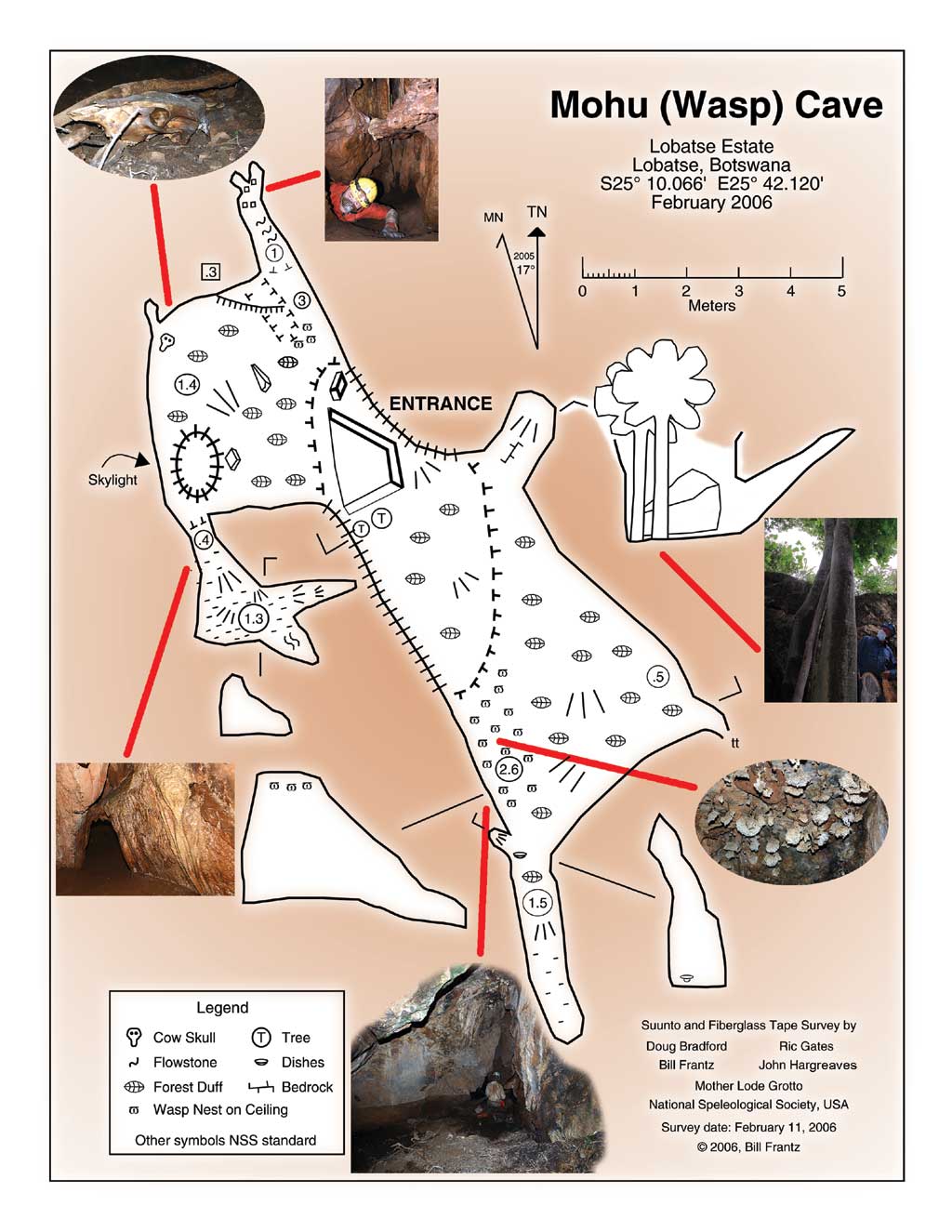
newly named Mohu cave was done. This data and sketches done by
Bill Frantz were later used to complete a map of the cave.
Mohu Cave
Plan View: Preliminary Line Plot
Mohu Cave
Profile View: Preliminary Line Plot
Invertebrates
•
Classification of cave adaptive strategies
•
Accidentals
•
Trogloxenes
•
Occasional Trogloxenes
•
Habitual Trogloxenes
•
Troglophiles
•
Troglobites
Lobotse
Caves
·
A few Accidentals
·
Lygaeid Plant
bugs, Meloid beeltes
·
Numerous
Occasional Trogloxenes
·
Wasps,
Mycetophilid flies, other flies. Carabid beetles, Tenebrionid beetles.
Cave
Dwellers
•
On initial quick survey, two species were found
to be reproducing in the Lobotse 1 cave
•
Tenebrionid beetle: Eurychora sp.
•
Blattid cockroach
Photography
This
task was accomplished with the use of several extra flash units and photography
equipment that had to be transported to the cave. The damp, and dusty
environments of these cave makes
photography somewhat more difficult then outside of a cave but advances in
digital cameras and equipment have helped to make this a little easier.
Preliminary Findings
There are large
piles of debris that have formed under the openings of both Lobatse cave #1 and
Mohu cave, both show high archeological/ anthropological potential. This is
supported by the bones that are viewable on the surface of the piles and the
similarities to the openings at caves such as near Sterkfontein in
The topography and geology of the area
suggests that there is a great deal of potential for further cave discoveries.
For example the surface survey of the sinkholes with gps co-ordinates shows that
they are located in a line that runs towards Lobatse cave #1.
These things all contribute
to the scientific interest of the caves in this region. There is potentially a
great deal of information to be gained in further studies and certainly more
aspects that haven’t even been considered yet. There is little other potential
for tourists or the casual visitor though, as the obstacles of travel and health
and safety hazards encountered
would not be likely to be endured by those simply visiting to see the area.
Participants
•
Leader: John Hargreaves
•
Rolf Aalbu
•
Doug Bradford
•
Bill Frantz
•
Peri Frantz
•
Ric Gates
•
Tom Inderkum
•
Carol Ward
] African corn cricket
The drought is over Gaborone, Botswana 2006
Trip report by John Hargreaves:
I departed Sacramento greatly excited, over two years of planning and I was finally on my way. The flights went just as planned but when I arrived in Johannesburg I ran into a small problem. My luggage wasn’t checked through to Botswana so I had to go through customs to claim my checked bags. After doing so I could not re-enter the international lounge in order to get to the hotel so I spent an uncomfortable night camped in the arrivals lounge. The next day I caught my flight to Gaborone with no problems though and arrived in Botswana where my Parents were waiting for me. In the rain! Despite My Dad’s previous assurances that Botswana’s drought made it very unlikely we would experience rain this was just the beginning and I was in store for more rain then I ever wanted to see. The rest of my group weren't due in yet so we went out for lunch and saw a movie, ‘Momma Jack’, a South African comedy by Leon Schuster.
The next day we headed out to the airport to greet the next arrivals but there was no one on the plane I recognized! We waited for the next flight arriving from South Africa and fortunately Tom, Karole, Doug and Ric were on it. Their luggage wasn’t though. We went and ate lunch as the next flight didn’t arrive till after 3:00pm. When it arrived Rolf, Bil and Perri were on board and so was all the luggage!
] Loading up the landrover at the airport[/caption]
We spent the next two days meeting with people from the Botswana National Museum and shopping for supplies. We found out that due to some bad timing and political matters the museum would not be involved in our caving project at the Lobatse caves but we did have an introduction to the property owner. ( The caves are on a private cattle estate.)
[caption id="" align="alignnone" width="400"] Rolf fooling around at the national museum. I'm pretty sure he's in
no danger, can't say the same for the sculpture![/caption] Finally
on Wednesday February 8th we were on our way to the
Lobatse estates to see some caves. We got a late start though after
deciding to get a trailer to help fit all our gear and trying to load
everything in between the thunder showers. It was nearly closing time
for the estate when we arrived at the gate but they were expecting us
so we had no problem at the gate. Getting to the estate office proved
to be a challenge though as there was a newly flooded river across
the road. My parents car would never make it across but their
landrover with Bill at the wheel had no problem crossing.
Rolf fooling around at the national museum. I'm pretty sure he's in
no danger, can't say the same for the sculpture![/caption] Finally
on Wednesday February 8th we were on our way to the
Lobatse estates to see some caves. We got a late start though after
deciding to get a trailer to help fit all our gear and trying to load
everything in between the thunder showers. It was nearly closing time
for the estate when we arrived at the gate but they were expecting us
so we had no problem at the gate. Getting to the estate office proved
to be a challenge though as there was a newly flooded river across
the road. My parents car would never make it across but their
landrover with Bill at the wheel had no problem crossing.
 River crossing.
A couple of trips saw us all across the river and checking in at the office. We were shown the location of Lobatse cave #1 which was about 4 kilometers from the office on a dirt track. After agreeing to meet my parents back across the river on Sunday morning we headed out to the area near the cave. As it was getting dark rapidly we all set about setting up tents and no sooner had we finished then it began to rain again. We ate huddled in a large tent then went to bed. It proceeded to storm throughout most of the night with booming thunder waking us occasionally. It continued till after 4 in the morning.
 Camp at the Lobatse Estate
The next day in spite of little sleep the excitement of seeing a new cave got me up early and as soon as we’d had some breakfast Doug and I rigged the drop into Lobatse cave #1, We were all very glad the rain had stopped. It was during all this that Doug announced the trip report should be entitled ‘the drought is over’ to which we all heartily agreed. Karole rigged up first to climb down into the cave and as she began her descent a beautiful white owl, possibly a barn owl flew out of the entrance. Bill, Ric and I followed her down. I was amazed to see the root structure of the fig trees at the entrance formed a column that extended all the way down the entrance shaft and into the talus cone at the bottom.
 Tom descends into Lobatse cave #1
The drop was approximately 18.5 meters. The talus cone contained several bones near the surface including some large horse like jaw bones and certainly future excavation properly carried out may reveal some interesting finds. There were also several small frogs and a small toad perched on the rocks on this pile. When Tom and Rolf had joined us at the bottom Rolf began eagerly collecting several of the flat, grayish cockroaches that crawled about on the cave floor. We continued into the cave and passed a section of chicken wire mesh fencing lying mostly on the ground though there was evidence that it had been put in place in the cave as in a couple of places the sticks used as fence posts were still in place. We found out later back at the Museum that the fence had originally been put in the cave by South African freedom fighters hiding in the cave during apartheid. We saw a lot of bats in the cave, I have posted pics of some of them on Inaturalist.org and have received possible identifications as
 Horseshoe bats Genus Rhinolophus and
 Egyptian slit-faced bat
Nycteris thebaica
Egyptian slit-faced bat
Nycteris thebaica
We also noticed that the number of bats appears to have increased greatly from the 500 or so reported previously. I would estimate they now number closer to several thousand. This and the large amount of corresponding guano may explain why shortly after we took a look around and observed the bats, Karole who had climbed up a ledge into a further part of the cave reported that the air was bad. We all retreated back to the entrance and posed for a few pictures as we enjoyed the fresh air there. I decided to check out the passage in the opposite direction away from the bats. I went down the talus slope and the passage quickly narrowed to a small squeeze. I slid through it easily enough but upon reaching the small room on the other side I immediately noticed I was breathing far too rapidly. I tried the bic lighter test and found the lighter would not even light in this space! I hastily retreated back to the squeeze where Bill took some pictures of me trying the lighter test and clearly showing a heavy layer of CO2. We all agreed that further exploration and survey in this cave was not a prudent move and so we planned to try and locate Lobatse cave #2 to see if there were more survey to be done there. Peri and I stayed to watch the camp as the others went on a hike to try and locate the second cave. Everyone returned around dinner time but they had not managed to locate the second cave.
 Testing for bad air -Photo by Bill Frantz
The next day Bill and I drove back to the office to ask for help locating other caves on the estate. After a little inquiry we were told two estate security guards that were in the area of our camp would help us so Bill and I headed back to camp. We arrived back to find they had already arrived and were leading several of our group to some sink holes that were nearby to Lobatse cave #1. On their return to the camp I asked about other caves on the estate and they agreed to ride in the landrover and show us some. We first drove about 5km to a hill that had 2 very small rock shelter type caves, one of which did have a pool of water in it that was rumored to be home to a large snake. Then we tried to drive on to where a larger cave (possibly Lobatse cave #2) was. On the way we saw Impala and Kudu as well as numerous birds. Before we reached the hill where the cave was though the ground became increasingly marshy and the landrover was stuck. After some shoving and some well placed logs our two guides and I managed to provide enough traction for Bill to back up and we attempted to drive around to the other side of the estate where there was a hill with yet another cave. We ran into more marshy ground but this time instead of risking getting stuck Bill backed the land rover to firmer ground and we proceeded on foot.
 Temporarily stuck landrover- the ground here was very wet.
We walked about 3 kilometers to the hill and climbed up to an outcrop where we found an opening. I crawled in past two turns and could see the passage continuing through a squeeze ahead. There was definite airflow coming out of the cave and a bat flew past my head. Indicating that this may be a sizable cave. By this time a troop of baboons further along the ridge were becoming increasingly agitated and hooting at us so we decided to head back down the hill before they got any closer. We returned to camp and while some of us started to prepare dinner Bill and Doug gave our guides a ride back to the office. It wound up though that they had to give them a ride all the way into the town of Lobatse. They became the Hero’s of the day when they returned to camp with cold drinks for everyone!
] Doug aka the wilderness chef hard at work cooking up moth
stew.
Doug aka the wilderness chef hard at work cooking up moth
stew.
That evening we sat up by the cave entrance and watched the bats fly out and a magnificent sunset.
 Sunset while we waited for the bats
Saturday we eagerly headed to the nearby row of sinkholes. We began by marking some of the entrances locations with our gps and then proceeded to what appeared to be the largest of these. The pit was only a little over two meters deep with a large rock and two trees in it. We rigged up a rope and Rolf climbed down in. He quickly warned us to watch out for wasps. There were numerous wasps nests all around the overhang of the entrance. They were primarily paper wasps but a couple of different types of mud daubers had also made nests there. We proceeded to survey the cave which had a couple of small off shoots that even contained some draperies and rim stone. We also noted several bones in the talus pile at the pit and some pots we found towards the back of the main area of the cave. And of course Rolf filled several vials with more beetles and cockroaches. We also saw a small 6cm long snake and a couple of small frogs in this cave. We decided to name this cave the local name for the paper wasps which were so prevalent. My Dad checked on the name for these in Setswana when we returned to Gaborone, and the name for the cave is now Mohu(wasp) cave. On the way back to camp Bill, Ric, Doug and I stopped at one of the promising looking sink holes that went back under a large tree root. It turned out to be a slot type cave which Bill and Ric climbed down to the bottom of. It was about ten meters deep and thirty meters long. Ric also poked into a small sinkhole but it didn’t go much further back then a meter or two. We returned to camp and started preparing to pack up to head back to Gaborone the next day.
 Why are we calling this wasp cave again?
 Bill sketching in Mohu cave
 Ric checking possible leads in Mohu Cave
 Dinner time at camp Lobatse
The following day we Loaded up the landrover and walked back to the office while Bill drove the landrover and then ferried us all across the river to where my parents were waiting. On the way back to Gaborone we saw a troop of baboons crossing the road in the rain.
] Baboons playing in traffic
We had dinner in Gaborone at ‘Something Fishy’, a fish and chips shop and began planning for our trip north Peri suggested and we all agreed that the car and trailer did not provide enough room for all ten of us and our gear so we would be renting another 4wd vehicle for the trip to Gcwihaba cave.
] Shopping at the mall
After our wet week at Lobatse we had plenty of muddy clothes so before heading out of town a trip to Kofifi Laundry was certainly in order. We wound up using almost all the washer / dryers in the place and the ladies that worked in the back had to go get us more change for the machines.
 Laundry at kofifi, waiting for the clothes to dry.
On Monday we had a busy day lined up including meeting with the museum director and a long list of errand to prepare for the trip north. Doug & Bill figured out how to use the high lift jack to change a tire and things were only complicated by the fact that the landrovers water pump had developed a pretty bad leak. We managed to get most of our various errands run though, get the landrover to the shop, meet with the Museum director and then pick up both the landrover and the rented Toyota hilux. We all enjoyed dinner at Nando’s with their legendary ‘Peri Peri’ sauce. For those who haven't tried peri-peri it's a spicy sauce of portugeuse/ Mozambique origin and there's a chain of Nando's all over southern Africa that serves delicious chicken cooked in this.
Tuesday we began our drive around the country by heading off to see the ‘great grey-green, greasy Limpopo River, all set about with fever-trees, to find out what the Crocodile has for dinner. ...’ , despite my Dad’s objection that it was just a river and out of the way. We tried to reach the closest crossing to our route north which was Buffels drift but found the track blocked by a new private game reserve, so instead we continued onto the village of Dovedale and eventually to Parrs halt where the boarder guards graciously let us walk across to view the river. We didn’t stay long though as it was continuing to rain the whole time we were there and soon we were back on the main road heading towards Francistown. I was driving the landrover and We had passed the town of Mahalapye by about 20km when the Toyota passed us rapidly. Turned out they were trying to warn us of a bulge in our tyre but they were too late. Just as they passed us there was a loud pop and the tyre blew. I was able to pull the landrover off the road before stopping but there wasn’t much room on the shoulder. Doug set to work with his expertise of the hi-lift jack and started to raise the truck. At that moment a torrential downpour hit. It was raining so hard we could barely move but Doug bravely struggled on with the jack, Ric and I pushed the spare into place and just as the rain subsided we were ready to get back on the road! Like they say I guess timing really is everything. The tyre we removed was shredded and we knew we would need to replace it before going further so we drove back to Mahalapye and ate dinner. We located a tyre shop and were told it would open in the morning so we drove to the Gaetsho lodge just outside of town and rented chalets for the night. Mom and Dad even performed a song “Baby it’s cold outside” at the bar for us.
] site seeing at the bridge across the Limpopo.
 The great green greasy Limpopo all set about with fever tree's!
Wednesday began with a quick trip to the tyre shop and breakfast and before breakfast was done we had a new tyre and were ready to be on our way. We made it to Francis town for lunch where we saw a fantastic collection of emperor moths. We arrived at the great pans shortly before dark and decided to camp at the Nata sanctuary despite warnings that there were mosquitoes. We attempted to drive out to the flat grassland of the pans to see if any animals were about but the ground was very marshy so Mom decided to turn back with the landrover. Peri thought maybe the ground would be drier further on and attempted to drive a little further. This led to our first experience with the winch on the landrover. After several tries we finally got it hooked up and managed to haul the toyota out of the mud and back both vehicle carefully to dry ground. What made this particularly humorous was some South Africans exiting the park had commented that they thought the Toyota would be fine but didn't recommend we drive into the park in the landrover.
] Landrover coming to rescue the toyota
Back at camp Ric was the hero of the day as he had brought a wisk broom to keep down the sand in our tents. That night we had hordes of mosquitoes so the warning was well deserved. Despite this Tom Inderkum entertained us with a plastic didgeridoo and we sang songs such as “You picked a fine time to leave us, loose wheel”, “Knee deep” and “One ton of Guano”. I’m sure stranger sounds have never echoed across the African savanna.
] Donkey cart along the way
Next morning we drove west to Gweta and stopped to see the giant Aardvark This giant monument was featured on the tv show ‘amazing race’ and is in fact a signpost for Planet Baobab which claims to be ‘The Kalahari Surf Club”. Normally I would guess this to be a joke but since the road to their lodge was completely covered in water who knows?
 Mom and Dad by the Giant Aardvark.
 Our first sighting of Ostrich.
We continued west and saw ostriches ,storks and lots of other birds on the way to Maun. There we checked into the Island Safari Lodge. The road to the lodge was an adventure in itself with large puddles the size of small ponds to be forded. We stayed two nights and the some of us visited the local game reserve. We watched a large tortoise near the entrance then braved the ants that covered the trail(and bit mercilessly at my sandal-ed feet) Bill and Peri even managed to spot a giraffe, The second day we were taken on Mokoro (dugouts) up into the Okavango. Here we saw a few birds, and more reeds, marsh grass and water-lilies then one could hardly imagine. We wound along a narrow channel in the reeds for over two hours before reaching an island where we could get off and eat lunch. Our guide, Cisco led us on a walk through the bush we saw only spore and footprints of elephants and hippos as all the animals had left to seek shelter from the noonday sun. We walked on though to see a baobab tree, more birds, a sausage tree( the best mokoro are made from sausage trees) and even a fleeting glimpse of a water buck before returning to our canoes for the ride back to the island safari lodge.
 Okavango delta water lilies.
 Baobob tree, Okavongo delta
On Saturday the 18th we set off to Gcwihaba cave. The dirt road in was covered with spectacular numbers of butterflies, mostly yellow. Unfortunately, the road became wetter and wetter with larger and larger fords or areas where vehicles were forcing there way through the bush to avoid getting stuck. The Toyota didn’t make it through one of these pools but we had our winching technique perfected and quickly pulled it out. The going over all was very slow though and as it got dark and it got harder to see in the rain I could see we wouldn’t be reaching the cave that night. We stopped just north of the Aha Hills. We camped on the spot and were inundated with thousands of moths. Next morning we found one of the Land Rover wheels was soft and so, due to this, the fact that we weren't sure of exactly how much fuel was left in the landrover and the overall road conditions, we turned back. We were all very disappointed not to reach the cave but agreed it was the wisest decision. On the way back we stopped at a small remote village when a young woman held out souvenirs for sale.
 butterflies all over the road, and huge ants!
 Tom says hi to the kids while we buy some souvenirs.
We managed to get to Sehithwa on the paved road but no tire repair was found. We also found our spare tire was going soft! Unsure where to stop for the night as there was no campground or lodge nearby my Mother suggested going to the police station. The Police allowed us to camp in their yard and even use the bathroom in one of their disused jail cells. We were inundated with hoards of spiky plant bugs. Early the next morning the Land Rover was left jacked up and Bill and Doug left with the wheels in the Toyota heading back to Maun. They made great time and arrived back just as we were taking advantage of the mornings sunshine to dry out our camping gear and repack the landrover. On the way out of town we passed a huge flock of egrets. We still managed to get to Ghanzi early enough to do souvenir shopping and enjoy the Kalahari Arms chalets. That night Rolf collected several of the large elephant dung beetles that were running around. On the way back to Gaborone we saw huge groups of yellow-billed kites and marabou storks, probably enjoying the excess insects.
 camped out in the police courtyard
 the next morning, waiting for the tire to be repaired
 Egrets taking flight
 Mariboo storks
On our return Peri had already created a power point presentation of our preliminary findings in Lobatse and with a little input from Rolf and myself we had a presentation which we gave at the National museum the next day. The lecture was fairly well attended and people seemed genuinely interested in the caves. We also arranged a game drive that afternoon at the nearby Mokolodi game reserve. A wonderful place that was formed in 1991 with the aim of promoting wildlife conservation and environmental education for the children of Botswana. Which means that trips that tourists like us pay for help to pay for school children to come and learn about the wildlife. Our guide did a great job finding all manners of critters including naturally-occurring animal species such as warthogs, steenbok, kudu as well as the re-introduced zebra, giraffe, eland, ostrich, and hippos. Which shows he had a good knowledge of the parks 30 square km. We didn't see the cheetahs but they probably saw us through the tall grass and the rhinos were off somewhere we never reached. The dinner at the Mokolodi restaurant that night was superb. Our waiter had a ready smile and after crocodile scampi, and Kudu medallions I felt like we were dining royally.
 Back in traffic in Gaborone, at least it's not raining for the moment.
 Elephant at Mokolodi
The following day we did some shopping then most of the group had to be driven out to the airport for their trip home. Rolf and I stuck around for a little longer and I even visited some more caves in south Africa with my parents, but that's for another report.
An introduction to Caves of Botswana
"The lime caves and gulleys of Botswana may yet provide evidence of the earliest humans to match discoveries in Olduvai, Omo or Gauteng. We also begin to see how people have adapted to different climates. Just a few thousand years ago the Okavango and Makgadikgadi formed one vast lake before they dried up into marshes and pans."
-From Ditswa Mmung by Neil Parsons
Reports
of previous expeditions
Gcwihaba Caverns(Drotsky's Caves)
Certainly one of the wildest and remotest of all tourist destinations in Botswana is the Gcwihaba Caves. These beautiful caves are situated 50km south east of Aha Hills and are set in the same undulating Kalahari dunes. There are two unspectacular low ridges of sand-covered rock at the entrance to the caves, but an enchanting spectacular curtain of stalactites is the first of many wonders inside this fascinating formation.
AHA HILLS
Isolation, peace, Kalahari sunsets and glorious birds are not the only compelling features at the Aha Hills. They have an additional appeal because they are one of the few places left in Southern Africa which have not been extensively explored and documented. They are enigmatic and the question that most visitors ask is,’ What are the chances of finding caves, similar to Drotsky’s Cave, here at Aha Hills?’ After all, the geography of the areas is the same. Thus far no caves have been found, but two large sink holes have come to light. The holes, about 15 kilometres apart, measure approximately 55 and 35 metres deep respectively.
Wadoum cave,
Kalahari
Wadoum cave, Kalahari .
Stalagmite with micro rimpools
Wadoum cave, Kalahari.
Hook type helictite developed on stalactite
Lobatse Caves
In south eastern Botswana 76 kilometres south of Gaborone. There are two known caves in this area. These caves occur within the chemical sediments of the Transvaal Supergroup which comprise dolomite that is interbedded with chert.
They occur in the same lithology as the South African caves which have important hominid fossils. Both Lobatse and South African caves probably experienced the same climatic and ecological conditions that led to their formation and deposition since they are in the same geological formations and geographical regions.
Koanaka Cave
Still in Ngamiland area, this cave has one entrance with wonderful deposits rich with fossiliferous breccia. The presence of stalactites, stalagmites and fossiliferous breccia makes the cave one of the great natural heritages of Botswana. It has several chambers. Research is still being conducted to establish the palaentological, paleoecological and palaeoclimatic conditions that this natural heritage has for Botswana.
Figure 2-6. Two fans of
aragonite (on right and left) that join to produce interfingering
crystals in the middle. Note how clearly individual needles of
aragonite can be resolved in this image. Preliminary dating suggests
that the age of this aragonite is in low hundreds of years.
Image
is a mosaic of two photomicrographs that were taken in cross
-polarized light; field of view is 2.2 mm wide. Bone Cave, Botswana;
Sample BC 97-14; thin section BC 97-14-2. Sample collected by Dr.
George A. Brook.
Caving in Botswana
This was to be our final day of exploration. Myself and Ron Ritter had spent the last few days completing the exploration, surveying and photography of Bone Cave, a cave stuffed full of three million year old fossils, located in the second of the Koanaka Hills in Botswana's empty north west corner. Tim Longden, the man I suppose Oxford's sterile tones would dub as our Home Agent, had flown out to join us the previous day, and so avoided a rather perilous two day drive through the bush.
We arose at first light and by an hour after sunrise we had packed and were roll-starting the land rover in readiness for the day's journey. Our target was the third of the Koanaka Hills, some twelve kilometres to our south west, and almost on the Namibian border. We had viewed the hill from the air, confirming that it was indeed a dolomite outcrop, protruding like an island from the desert surface, and not just another sand dune. Its surface appeared badly broken up, with a lot of loose rock, and its size, only 200m long and 30m high, didn't inspire enthusiasm. However, its sheer location was enough for us, being one of the earth's most remote and unvisited corners; before us only the earliest map makers and the geological survey had disturbed this sparsely occupied bushman territory. Also this was the last place we had left to investigate, once we'd searched this hill thoroughly our project would be complete.
We arrived at the hill before the sun climbed uncomfortably high, and located a slope on which to stop the land rover. As we broke into a packet of peanuts Tim summoned me over to where he was sitting. He passed me a small stone flake, wanting confirmation that it was what he thought it to be, a stone age tool. It appeared to be, but as I tried to explain that as one cuckoo doesn't make a spring..., he placed two more in my hand. Obviously we had a site, but probably only thousands and not millions of years old. Nonetheless, this discovery vindicated our journey, guaranteeing the hill a right to protection as a national monument, and strengthening our case for gazetting an extensive protected area in the region. More immediately, it was mind-boggling to have such tangible evidence that thousands of years ago people were sitting here, resting and probably snacking in almost exactly the same manner us. Minutes later, the sound of "CAVE..CAVE..CAVE..CAVE..CAAAAAVVVE !", our official cave discovery call, resounded over the whole of the hill. Before me was the top of a dark hole that I had investigated to a depth of eight metres and the top of a large drop. This call resounded twice more in the next half hour as we continued checking the hill thoroughly; cave discovery wasn't meant to be this simple. We only made notes of the entrances we could get into easily, holes that might involve squeezing or digging would be investigated later only if need arose.
After an early lunch, we picked the largest entrance, donned our caving gear (hard-hat, lamps, shorts and T-shirt), and started our descent. We clambered down into a large entrance chamber, lit by several fissures back to the surface. In the corner of this chamber a dark hole beckoned, we climbed over a few rocks, and paused for eyes to adjust to the darkness. We were standing at the top of a long slope, our lights feebly lighting only our immediate surroundings, the only wall we could see was the one behind us, daylight diffusely filtering through the hole in it. "Wow" was all Tim could say as we carefully picked our way down the slope, Ron and I were equally gob smacked by the place even if not so expressive. Our way was blocked several times by short drops, each time we found an alternative route on. To our left was the top of a large breakdown pile, black gaps gaping down between the room sized boulders, to our right was a long steep drop.
Eventually our way was blocked by an eight metre drop in front of us; we seemed to be perched overlooking an arcade like passageway, 10m wide and 20m high, extending away to our right. The passage continued to the left in a much diminished form, but was accessible after a short boulder climb. The passage closed down after only thirty metres, but as it seemed that our days work was done, I noticed a promising crack in the far wall. Stooping through, I was greeted by darkness again. "Come and have a look over here" I called back; our heartbeats raced once again as it became clear that this was a parallel gallery to the previous, and obviously an equal to it in size. The two galleries merged with several others to form an impressively large chamber, over twenty metres high, and forty in diameter. Each of the galleries led off, some for as much as fifty metres, but each seemed to close down into banks of sand, bat guano or stal. There were a few nice pools of cave pearls, but these seemed trivial when compared to the !Wa Doum cave, but other than the boulder pile, it seemed we'd worked this cave out. Sitting down on a breakdown pile in one corner of the main chamber, chewing on some biltong, we reflected on our dilemma. The cave was impressive, of that there was no doubt. There was more to do in this cave than we could give time for now, the survey would take a day, then there were a few leads to look at, and photography. On the other hand there wasn't really enough to justify the time and cost of another trip out here, even if in our hearts we knew that wouldn't stop us. Getting up, I took a snooped right into the corner. Between the rocks I could see space, not the solid rock I was expecting. I called out "I think I've got something" as I dropped myself between the rocks. I found myself looking along another of the caves galleries, instinct told me that this one went somewhere. A couple of minutes later we were gathered around a most amazing find, Botswana's largest known underground lake. Actually it was a stal dam holding back about fifty litres, filled by the rains that had percolated through the forty metres of rock above, but still it was unexpected.
Two minutes later we found ourselves standing in another large chamber, again the merging point of several galleries. More gasps of awe, as we took in the scene. The chamber wasn't quite as large as the previous, but it appeared to have more passageways leading off it. The colour of the rock was particularly clear here, all the clean surfaces were a dark battleship blue. We started another systematic exploration, but found this wasn't so easy here. We found ourselves entering a large maze of passageways, and resorted to cairning our route. An hour here left us none the wiser as to the maze's layout, we hadn't even investigated the higher levels we could see up into in a number of places.
This was how we had to leave the "Blue Cave" that day;
time and light was against us as we drove back to our camp that
evening, but spirits were high. We had found over a kilometre and a
half of cave that day, this was taken up to two when we returned a
week later to complete our explorations, making it Botswana's largest
cave. After two months of hard work in the field, this third cave was
the icing on the cake for us. It may not have been the most
spectacular, nor the most historically significant; we're quite sure
that there are much larger caves waiting to be discovered; but to us
the adventure of this caves discovery makes it quite
unforgettable.
Paul Mann